
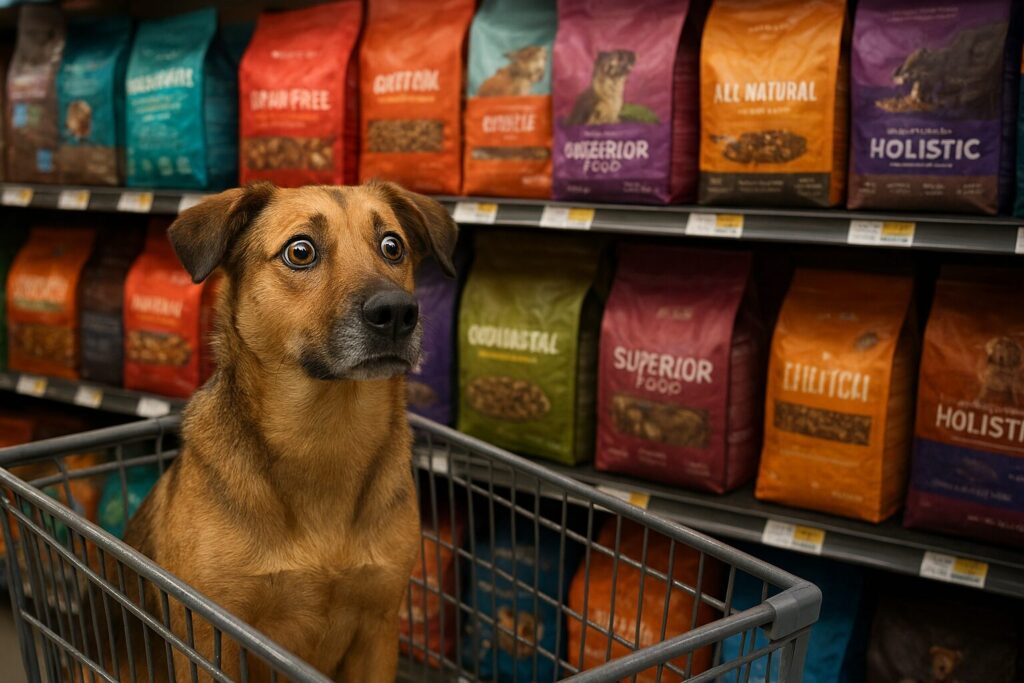
If you’ve ever stood in the dog food aisle staring at 47 bags of kibble, wondering if “wild-caught salmon” is code for “we found it in a puddle,” this article is for you. Choosing the best dog food for your pet isn’t just about avoiding marketing gimmicks—it’s about science, budget, and making sure your dog doesn’t stage a gastrointestinal protest at 2 a.m.
Yes, there are affiliate links here. If you click them, I might earn a small commission. It won’t buy me a yacht, but it might buy my dog a squeaky toy shaped like a taco. Priorities.
Contents
- 1 1. Verify Complete-and-Balanced Nutrition
- 2 2. Match Life Stage and Size
- 3 3. Prioritize Named Proteins
- 4 4. Assess Macronutrients for Your Dog’s Lifestyle
- 5 5. Consider Cost Tiers Without Shame
- 6 6. Check for Vet-Formulated or Feeding Trials
- 7 7. Transition Slowly (The 7-Day Rule)
- 8 Bonus: Red Flags to Avoid
- 9 Suggested Brands by Tier
- 10 Related Articles on PetEnrichmentHub.com
- 11 References
1. Verify Complete-and-Balanced Nutrition
The first step in finding the best dog food for your pet is checking for the AAFCO nutritional adequacy statement. This isn’t just fine print—it’s the difference between a food that sustains life and one that’s basically a crunchy placebo.
- Science bit: Dogs need at least 37 essential nutrients. Without them, you risk deficiencies that can lead to skeletal, cardiac, or neurological issues.
- Pro tip: “For intermittent or supplemental feeding only” = not a full diet. That’s like living on protein bars forever. Tempting, but no.
2. Match Life Stage and Size
Puppies are chaos machines. Seniors are dignified chaos machines. Both need different diets.
- Puppies: Higher protein and fat, plus DHA for brain development.
- Adults: Balanced energy to maintain weight.
- Seniors: Lower calories, more joint support (glucosamine, chondroitin).
- Large breeds: Need carefully balanced calcium-to-phosphorus ratios to avoid skeletal issues.
This is why the best dog food for your pet isn’t necessarily the same as your neighbor’s golden retriever’s food.
3. Prioritize Named Proteins
If the label says “meat by-product,” imagine a hotdog made by a committee. If it says “chicken meal,” that’s actually concentrated protein and perfectly fine.
- Science bit: Studies show dogs digest named animal proteins more efficiently than vague “meat blends.”
- Fun fact: Dogs can digest cooked starches better than wolves, thanks to extra copies of the AMY2B gene. Evolution: it’s why your dog can eat rice but your wolf can’t.
4. Assess Macronutrients for Your Dog’s Lifestyle
A couch potato pug doesn’t need the same diet as a sled dog.
- Protein: 18–25% for most dogs, up to 30%+ for working breeds.
- Fat: 10–15% for maintenance, higher for active dogs.
- Carbs: Not essential, but fiber supports gut health.
Choosing the best dog food for your pet means matching these numbers to their actual lifestyle, not your aspirational “we’ll jog together every morning” fantasy.
5. Consider Cost Tiers Without Shame
Yes, there are tiers. No, your dog won’t judge you (they eat socks).
- Budget-Friendly: Meets minimum standards, often grain-heavy. Example: Purina Dog Chow.
- Mid-Range: Named proteins, fewer fillers, better balance. Example: Hill’s Science Diet.
- Premium/Fresh: Human-grade, often subscription-based, highly digestible. Example: The Farmer’s Dog.
Science bit: Digestibility studies show premium foods often provide more usable nutrients per calorie, meaning you may feed less overall.
6. Check for Vet-Formulated or Feeding Trials
Some brands hire veterinary nutritionists. Others hire marketing interns with clip art. Choose the former.
- Feeding trials: Gold standard. They prove dogs can actually thrive on the food.
- Formulated to meet standards: Acceptable, but less rigorous.
If you want the best dog food for your pet, look for brands that publish research or employ board-certified veterinary nutritionists.
7. Transition Slowly (The 7-Day Rule)
Switching overnight is like giving your dog a burrito buffet after years of plain rice. Disaster.
- Days 1–2: 75% old, 25% new
- Days 3–4: 50/50
- Days 5–6: 25% old, 75% new
- Day 7: 100% new
Science bit: Gradual transitions reduce digestive upset by up to 80%. That’s fewer midnight carpet cleanups and more sleep for you.
Bonus: Red Flags to Avoid
Because sometimes knowing what not to buy is half the battle.
- “All-natural” with no AAFCO statement.
- Grain-free without medical need (linked to dilated cardiomyopathy in some dogs).
- Foods with artificial dyes (dogs don’t care if kibble is red).
Suggested Brands by Tier
🐾 Budget-Friendly
Purina Dog Chow
“The reliable old sedan of dog food—gets the job done, no frills, no judgment. Your dog won’t care that you didn’t remortgage the house for kibble.”
Pedigree Adult Complete Nutrition
“Think of it as the fast-food combo meal of dog diets: affordable, filling, and surprisingly satisfying if you’re not too picky about the garnish.”
🐾 Mid-Range
Blue Buffalo Life Protection Formula
“For dogs who deserve a little more than the basics—like the difference between a motel and a hotel with free waffles.”
Hill’s Science Diet Adult
“Vet-approved, science-backed, and about as glamorous as a lab coat. Not flashy, but your dog’s gut will thank you.”
Nutro Wholesome Essentials
“The Whole Foods of kibble: clean ingredients, wholesome vibes, and packaging that makes you feel like you’re a better human.”
🐾 Premium/Fresh
The Farmer’s Dog
“Fresh, human-grade meals delivered to your door. Yes, it costs more than your own groceries. Yes, your dog will eat better than you.”
Nom Nom
“Perfectly portioned, freshly cooked meals. It’s like meal-prep Sunday, except someone else does the chopping and your dog actually appreciates it.”
Orijen
“For dogs who think they’re wolves but also enjoy central heating. High-protein, biologically appropriate, and unapologetically extra.”
Farmina N&D (Natural & Delicious)
“Italian-crafted, high-protein recipes with ingredients like pomegranate and pumpkin. It’s the foodie version of kibble—your dog basically gets a Tuscan vacation in a bowl.”
Related Articles on PetEnrichmentHub.com
- The 6 Best Dog Enrichment Toys to Relieve Boredom and Boost Playtime
- The 5 Best Lick Mats for Dogs: Calm Anxiety and Make Mealtime Fun
- Essential Senior Dog Enrichment: 6 Ways to Keep Aging Pups Engaged, Confident, and Comfortable
- The 5 Best Snuffle Mats for Dogs: Turn Dinner Into a Treasure Hunt