
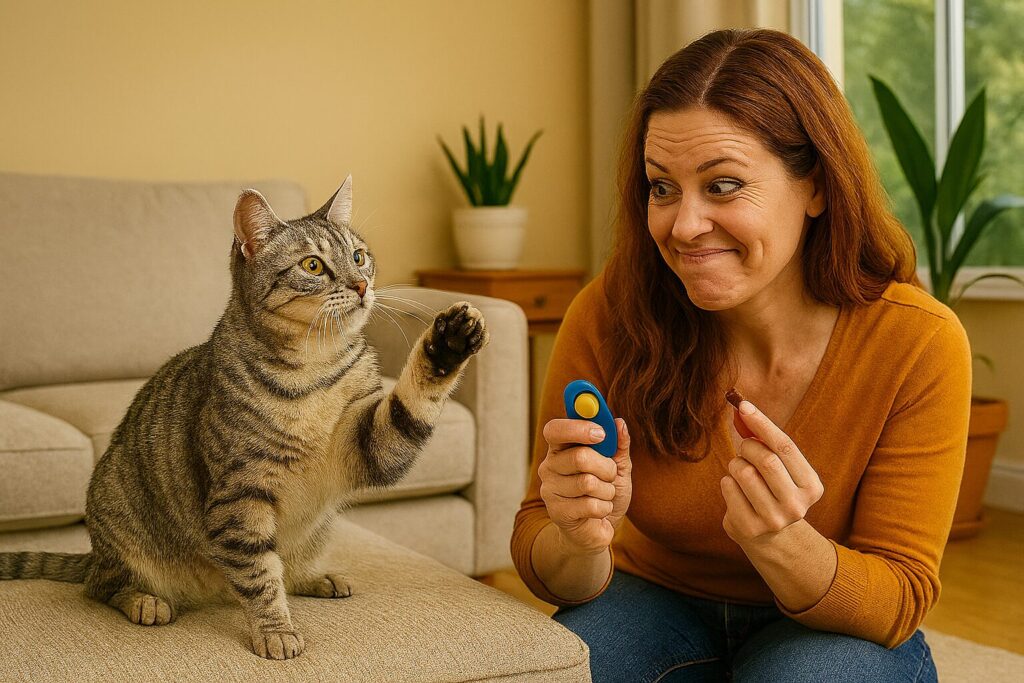
Clicker training for cats sounds like a punchline — until your tabby high-fives you for a treat. If you’ve ever wished your feline overlord would stop knocking things off shelves and start showing off their hidden genius, this guide is your new best friend. With a little patience (and a lot of snacks), you’ll turn meows into milestones and build a bond that’s smarter, sweeter, and surprisingly cooperative.
As an Amazon Associate I earn from qualifying purchases. The clickers, treats, and feline negotiation tools linked here may earn me a small commission — not enough to buy your cat’s loyalty, but enough to keep the tuna flakes flowing.
Can you train a creature that routinely ignores its own name, your voice, and the laws of gravity? Yes — if you make it feel like their idea. Clicker training isn’t obedience. It’s diplomacy. And your cat? They’re the ambassador of chaos.
Contents
What Is Clicker Training (And Why Would a Cat Care?)
Clicker training is operant conditioning with a side of snacks. You click. You treat. Your cat thinks, “Finally, this human understands my worth.”
Eventually, your cat associates the click with a reward. Then you use it to reinforce behaviors like sitting, staying, or not launching themselves onto the kitchen counter like a furry missile.
Why it works: The click becomes a precise marker — a bridge between action and reward. It’s like saying “yes” in a language your cat actually respects. For anyone curious about clicker training for cats, this is the foundation: timing, consistency, and snacks.
Why Clicker Training for Cats?
Because cats are brilliant. And bored. And occasionally evil. But mostly brilliant. Clicker training for cats channels that intelligence into something constructive (and occasionally hilarious).
Training gives them:
- Mental stimulation
- Reduced anxiety
- Better adaptability to change (like moving houses or accepting that the vacuum isn’t a demon)
- A sense of agency — which they already believe they have, but now you’re validating it
Is it weirdly satisfying? Yes. Like solving a puzzle that occasionally bites you.
What You’ll Need
- A Clicker: Any basic model will do. Or use a pen cap if you’re chaotic neutral.
- Tiny Treats: Freeze-dried chicken, tuna flakes, or whatever your cat would sell your soul for.
- A Cat: Preferably one that’s awake and not actively plotting your downfall.
- Optional: A sense of humor. Band-aids.
Pro tip: The best clicker training setups are simple — a clicker, a treat, and a cat who’s at least mildly interested in your existence.
Step-by-Step: How to Clicker Train Your Cat
Clicker training for cats works best when sessions are short, positive, and end before your cat decides to file a complaint with HR.
1. Charge the Clicker
Sit near your cat. Click → Treat → Repeat. Do this 10–15 times until your cat starts looking at you like you’re a vending machine.
2. Pick a Behavior
Start simple:
- Touching a target (like a spoon or your finger)
- Sitting
- High-five (yes, really)
3. Mark the Behavior
Wait for your cat to accidentally do the thing. Click the moment it happens. Treat immediately.
4. Add a Cue
Once your cat consistently does the behavior, add a verbal cue like “sit” or “high-five” — or “please stop judging me.”
5. Practice in Short Bursts
Cats have short attention spans. Train for 2–5 minutes max, then let them return to whatever existential crisis they were having.
Troubleshooting (Because Cats Are Chaos)
- Cat walks away mid-session? Totally normal. You’re not boring — they’re just emotionally unavailable.
- Cat ignores the clicker? Try higher-value treats. Or apologize for whatever you did in a past life.
- Cat starts training you? Congratulations. You’ve unlocked the final boss.
Final Thoughts: Training Is a Conversation (With a Diva)
Clicker training isn’t about control. It’s about communication. It’s about saying, “I see you, tiny predator. Let’s collaborate so you stop knocking over my water glass at 3 a.m.”
It’s also a way to bond. To build trust. To laugh when your cat high-fives you and then immediately bites your ankle. Because that’s love. And also mild trauma.
So grab a clicker. Grab some treats. And prepare to be amazed — or at least mildly entertained — by what your cat is capable of when they think it’s their idea. With patience, humor, and consistency, clicker training for cats can turn chaos into connection.
Related Articles:
- 5 Genius Dog Training Games That Build Intelligence (and Bonding)
- 7 Irresistible Indoor Pet Enrichment Ideas for Rainy Days: Fun Without the Mess
- 7 Outrageous DIY Catio Ideas That Might Just Earn Your Cat’s Forgiveness
References:
- How to Clicker Train a Cat: 4 Vet-Approved Steps – Catster
Outlines the science and step-by-step process of clicker training, including charging the clicker, marking behaviors, and using high-value treats to reinforce learning. - Clicker Training for Cats: Teach Your Cat to Sit, Stay, and More – The Spruce Pets
Supports your article’s emphasis on short sessions, toy-based rewards, and the importance of timing and consistency when training feline behaviors. - How to Clicker Train a Cat: Beginner’s Guide to Positive Reinforcement – Saving Nine Lives
Explains how clicker training strengthens the human-cat bond, reduces anxiety, and taps into natural feline instincts using clear cues and structured repetition.